Tag: writing

  • The Stolen Legacy – Chapter 3: Whispers in the Halls

    The Stolen Legacy is the first case in the Leila Voss & Associates files. Set in 1920s Britain, it follows detective Leila Voss, Josh Thorne, and Pete Smith as they unpick a theft that runs deeper than anyone expects. Each chapter will appear here as the story unfolds in the shadows.

    Cinematic 1920s photorealistic cover image for a detective mystery chapter titled "Whispers in the Halls". A grand Glasgow university gallery corridor at dusk, long stone hallway with arched windows letting in dim golden light, dust motes in the air, an empty ornate picture frame on the dark green wall, leather-bound ledgers on a nearby desk, a crumpled piece of paper on the floor. Moody noir atmosphere, dark shadows, golden and deep green tones. No people visible. Feels like someone just left in a hurry.

    Chapter 3 – Whispers in
    the Halls

    Glasgow, The Hunterian Gallery – Second Day

    Morning came slowly to the gallery. Light
    through the high, dust-flecked windows in pale, reluctant beams, casting long
    shadows across the parquet floor. To any casual visitor, the building had
    resumed its ordinary rhythms — quiet footsteps, low voices, the occasional
    scratch of a pencil on a catalogue card. To Leila, every sound carried weight.

    She had claimed an archive desk before the doors opened,
    arranging herself among the leather-bound ledgers like someone who belonged
    there. Her green eyes moved steadily across the pages: mismatched dates,
    smudged signatures, gaps in the guard rosters that no one had thought to
    explain. The theft had not been impulsive. Whoever had taken the portrait had
    spent months preparing the ground — planting false entries, quietly shifting
    patrol routes, hiding their alterations in the dull camouflage of administrative
    routine.

    Someone inside this building had helped them. She was
    certain of it now.

    Pete, meanwhile, moved through the gallery as though he
    had always belonged to it. As Julian Laurent — a visiting art historian from
    Edinburgh, charming and slightly vague — he drifted from the main hall to the
    studio wing, his easy manner opening doors that a blunter instrument would have
    found firmly closed. By mid-morning he had positioned himself beside a display
    case, deep in conversation with two art students who had been present the
    morning the theft was discovered.

    “Such a tragedy — the golden portrait,” he said
    softly, letting his gaze drift to the empty wall. “I had studied it quite
    closely before the week was out. It felt almost alive, didn’t it? The way the
    light caught the gilding.”

    One of the students — a young woman with ink-stained
    fingers and a careful expression — glanced over her shoulder before she
    answered. “They say it wasn’t only stolen for money,” she said, her
    voice dropping. “Old Mr. Hale. The senior curator. He’s been acting
    strangely for weeks. Locked rooms. Meetings at odd hours. And he knows every
    hidden passage in this building.”

    Pete smiled pleasantly and said nothing. He was already
    thinking.

    Cinematic noir photorealistic cover image for Chapter 3 "Whispers in the Halls". A grand Scottish gallery interior at dusk, amber light casting long shadows across marble floors. An ornate empty picture frame hangs on a stone wall, its hooks bare. In the foreground, a leather-bound ledger lies open on a desk with a fountain pen resting on it. Fog drifts outside tall arched windows. Dark, atmospheric, mysterious. 1920s-1940s noir aesthetic.

    Josh completed his rounds near dusk. His footsteps were
    steady and unhurried on the stone floors, his eyes moving across every shadow,
    every seam in the wainscoting, every door that sat a fraction less than flush
    with its frame. At the back service entrance he crouched and examined the lock
    — a single fresh scratch, barely a hair’s width, invisible unless you were
    looking for it. Someone had been through here recently, and not with a key.

    Further along the corridor, half-concealed beneath a
    wooden bench, he found the paper. A rough sketch on cheap stock: a floor plan
    of the gallery, quick and confident, drawn by someone who knew the building
    well. The portrait’s former position was marked in faint pencil. Beside it, a
    small cross. Somewhere else entirely.

    That evening, they gathered in their rented rooms above a
    chemist’s shop on Byres Road, the window cracked against the smell of
    turpentine and coal smoke drifting up from the lane below. Pete laid out what
    he had. “Hale is the key,” he said. “He’s in serious debt — and
    he’s been meeting with a man the students couldn’t name but I can. A known
    smuggler. Works the Clyde.”

    Leila set the floor plan sketch on the table beside the
    ledger notes, smoothing both flat with her palm. “He didn’t act
    alone,” she said. “But he made mistakes. The rosters, the scratch on
    the lock, this sketch — he was careful, but not careful enough.” She
    tapped the small cross on the plan. “And the portrait isn’t far. They
    haven’t moved it yet.”

    Josh nodded, his hand resting near his jacket. “I’ll
    watch Hale’s quarters tonight. If he moves, I’ll know.”

    Outside, the fog had returned — thick and close, settling
    around the university buildings like a held breath. The city was quiet. But
    somewhere inside the gallery, behind a locked door or beneath a flagstone, the
    portrait was waiting. And so, Leila suspected, was whoever had put it there.

  • Chapter 3 is Coming Tuesday 8th September…

    A grand dark hallway, shadows stretching across marble floors, a single silhouette at the far end. 1930s noir.

    The halls of Whitmore House hold more secrets than servants. Leila Voss is inside — and the whispers are getting louder.

    Someone in that house knows exactly what was stolen. The question is whether they’ll talk — or disappear.

    Chapter 3 drops Tuesday 8th September. Don’t miss it.

  • The Words Will Come — Give Yourself Permission to Start

    A cosy, warm writing desk scene — vintage typewriter, a steaming cup of tea, soft lamplight, scattered handwritten notes and an open notebook. Warm golden tones, atmospheric and inviting. Photorealistic.

    Every writer knows the feeling — the blank page staring back, the cursor blinking like it’s judging you. But here’s the truth nobody tells you enough: you don’t have to write perfectly today, you just have to write something.

    The best chapters, the best stories, the best sentences you’ll ever put down didn’t arrive fully formed — they started messy, uncertain, and a little bit brave.

    So make the tea, open the notebook, write the bad first draft. It’s not wasted time, it’s the work. You’ve got a story worth telling. Don’t let the blank page convince you otherwise.

  • The Stolen Legacy – Chapter 2: Undercover Roles

    The Stolen Legacy – Chapter 2: Undercover Roles

    The Stolen Legacy is the first case in the Leila Voss & Associates files. Set in 1920s Britain, it follows detective Leila Voss, Josh Thorne, and Pete Smith as they unpick a theft that runs deeper than anyone expects. Each chapter will appear here as the story unfolds in the shadows.

    Chapter 2 – Undercover Roles

    Glasgow, The Hunterian Gallery – Late Afternoon

    The gallery had grown quiet in the hours since the police left — too quiet, the kind of silence that settles in a room after something irreplaceable has been taken from it.

    They stood before the empty golden frame, mist curling against the tall gallery windows. Leila studied it for a long moment, then turned to face them — her plan already formed, precise and deliberate.

    “Our cover must be flawless,” she said, voice low. “We’re not investigators here. We’re not outsiders. We belong inside the world that surrounds this painting.”

    She turned to Josh first. “You’ll take a position as night security — recently arrived from the north, quiet, dependable. Ask nothing. See everything. Learn the blind spots, watch the corridors, and pay attention to anyone who moves too easily through locked doors. Thieves know each other by instinct. You’ll feel them before you see them.”

    Then to Pete, a faint smile. “You become Julian Laurent — visiting art scholar from the continent. Charming, curious, wealthy enough to seem harmless, knowledgeable enough to be welcomed. Mingle with the students, the dealers, the regulars. Flatter their opinions. Listen to their gossip. Find out who’s been asking about the portrait — or who’s been seen lately with too much gold and too few scruples.”

    “And you?” Pete asked, already straightening, his manner shifting into something easier, more cultured.

    “I’ll be the new assistant curator,” Leila answered, green eyes steady. “Quiet, meticulous, buried in the archives. I’ll trace the painting’s history — check for altered documents, forged permissions, hidden access routes. I’ll find out how they entered without a trace, and what exactly they were looking for beneath the paint.”

    That evening, their new lives began.

    Pete drifts through the Hunterian Gallery at night, charming art dealers and students under warm gas lamp light

    Josh reported for duty, his broad frame settling naturally into the guard’s uniform. Pete drifted through the gallery halls, his smile earning trust in minutes. Leila sat at a cluttered desk surrounded by ledgers, digging quietly into the past.

    But as the gallery doors locked and the city fell dark, the silence felt different — watchful, intent.

    Somewhere in Glasgow, the stolen portrait was hidden. And somewhere close, someone already knew they were here.


    Chapter 3 drops Tuesday. Don’t miss it.

  • Chapter 2, is Coming Tuesday 1st Setember…

    A moody, atmospheric 1920s noir styled scene. A dark wooden coffee table with a small stack of hardcover books. The top book has "Leila Voss & Associates" embossed on the cover in gold lettering. Beside the books is a steaming hot cup of coffee in a vintage cup and saucer. On the table is an open notepad with handwritten jotted notes, and clearly written in ink "Chapter 2 Soon" on the notepad. Soft warm light, smoky atmosphere, shallow depth of field, cinematic film noir mood.

    The city doesn’t sleep — it waits. Ink-stained clues on a coffee table, shadows pooling between dog-eared pages, and Leila Voss following a trail no one else can see.

    Something was stolen long before the crime ever made the papers. In Chapter 2, the past knocks back.

    Chapter 2 drops Tuesday.

  • Podcast Episode: The Stolen Legacy Chapter 1

    Photorealistic cinematic cover image for a detective noir story. A dimly lit Glasgow art gallery at dusk, fog pressing against tall windows, a shadowy figure of a woman in 1930s detective attire standing before an empty ornate picture frame on a grand stone wall. Dramatic chiaroscuro lighting, deep shadows, moody atmosphere. The words "The Stolen Legacy" subtly visible. Film noir aesthetic, rich dark tones of navy, gold and shadow.

    This week, Pip and Mara slip back into the case files for Chapter 1 of The Stolen Legacy — a stolen portrait, a hidden vault map, and a team of investigators boarding the overnight train to Glasgow. The fog is thick, the timetable is unforgiving, and every carriage holds someone who might be reading that map. Spoilers ahead.

    Pip: A fog-wrapped London office, a breathless telegram, and a stolen painting hiding a vault map — welcome to detective156, where the mysteries are layered and the 1920s atmosphere is doing serious heavy lifting.

    Mara: Lucy Cordell has opened a new serial here, and today we’re stepping into the first case of the Leila Voss and Associates files — a theft in a Glasgow gallery that turns out to be about much more than missing art.

    Pip: Let’s start with the empty frame.

    The Stolen Legacy

    Mara: The Stolen Legacy sets up a serial mystery rooted in 1920s Britain — the question from the very first scene is not just who took the painting, but why, and what they intend to do next.

    Pip: The telegram that kicks everything off arrives smudged and urgent, and it already tells you this isn’t a straightforward theft. The message reads: “GOLDEN PORTRAIT STOLEN FROM HUNTERIAN GALLERY STOP FRAME LEFT EMPTY STOP NO TRACE STOP ARTWORK CONCEALS FAMILY SECRETS AND VAULT MAP STOP NEED YOU THREE AGAIN STOP.”

    Mara: So the painting isn’t valuable simply as art. What’s hidden beneath the paint — a coded guide to the MacLeod family’s oldest vaults — is what makes it dangerous. The wrong person reading it puts everything the team has previously uncovered at risk.

    Pip: And the scene at the gallery confirms the theft was deliberate and unhurried. Two precise, narrow impressions in the dust — not a dragged canvas, but a painting set down carefully. Whoever did this paused. They had a plan beyond simply walking out the door.

    Mara: Leila’s read of that detail is the sharpest moment in the chapter. She murmurs, “Whoever took it worked fast. And they haven’t finished yet.” It’s a short line, but it reframes the whole case — the theft isn’t the end of something, it’s the beginning.

    Pip: The three investigators each arrive at the problem differently, which is worth noting. Leila reads the physical evidence. Josh flags the operational knowledge required — no alarms, no forced entry, someone who knew the gallery’s blind spots. Pete is already thinking about cover stories and the art-world circles he’ll need to infiltrate.

    Mara: That division of approach is established very quickly, and it does a lot of work for a first chapter. The reader understands each character’s role before the team even boards the overnight train north.

    Pip: A stolen portrait concealing a vault map, a gallery scene that raises more questions than it answers — the serial format suits this kind of slow reveal.

    Mara: And with the clues still in place and the thief clearly not finished, there’s plenty of ground left to cover as the story unfolds.


    Pip: A first chapter that hides its real stakes inside a gilded frame — that’s a promising way to open a serial.

    Mara: The next instalment will tell us whether the hesitation in that gallery dust means what Leila thinks it does.

    A vintage 1920s carbon microphone sitting on a dark wooden desk in a smoky, dimly lit room. Dramatic noir lighting with golden gas lamp glow, wisps of cigarette smoke curling through the air, dark moody atmosphere. Cinematic and atmospheric, black and gold tones, photorealistic style.

  • The Stolen Legacy — Subscribe & Follow the Story

    Step into The Stolen Legacy

    Welcome to The Stolen Legacy, a new serialised mystery set in 1920s Britain and following the sharp-eyed detective Leila Voss and her circle of unlikely allies as they unpick secrets, scandals, and a crime that refuses to stay buried.

    New chapters arrive regularly and, if you subscribe, each one will slip straight into your inbox for free—no fuss, no spam, just the next piece of the puzzle waiting for you to unfold it.

    Chapter 1 is already live and ready to read. You can begin the story here: Read Chapter 1 of The Stolen Legacy, then make sure you don’t miss a step in the investigation by subscribing via the newsletter sign-up on this page.

    Thank you for reading and for keeping Leila Voss company in the dark.
    L. Cordell

  • The Stolen Legacy – Chapter 1

    Cover illustration for The Stolen Legacy case file

    The Stolen Legacy is the first case in the Leila Voss & Associates files. Set in 1920s Britain, it follows detective Leila Voss, Josh Thorne, and Pete Smith as they unpick a theft that runs deeper than anyone expects. Each chapter will appear here as the story unfolds in the shadows.

    Chapter 1 – The Empty Frame

    London to Glasgow – Late Winter, 1920s

    The fog in Marylebone was thicker than usual, pressing against the windows of No.7 Clay Street like a silent witness. Inside, the office was quiet—only the scratch of Leila’s pen and the distant rattle of a carriage breaking the stillness. Then the telegram arrived, delivered by a breathless messenger, its paper cheap and ink smudged by haste.

    Leila tore it open. Her green eyes scanned the lines, sharpening with every word.

    POST OFFICE TELEGRAPHS
    GOVERNMENT TELEGRAM FORM
    G.P.O.
    STAMP
    OFFICE OF ORIGIN
    LONDON MARYLEBONE
    WORDS
    27
    TIME HANDED IN
    9.47 AM
    CHARGE
    3/6
    SERVICE INSTRUCTIONS
    EXPRESS — URGENT DELIVERY
    DATE
    18 FEB 1927
    TO MISS L VOSS, 7 CLAY STREET, LONDON
    URGENT STOP GOLDEN PORTRAIT STOLEN FROM HUNTERIAN GALLERY STOP FRAME LEFT EMPTY STOP NO TRACE STOP ARTWORK CONCEALS FAMILY SECRETS AND VAULT MAP STOP NEED YOU THREE AGAIN STOP – SIR ALISTAIR MACLEOD
    FROM SIR ALISTAIR MACLEOD, GLASGOW
    SIGNATURE OF OFFICER

    She passed the note to Josh, who stood by the mantelpiece, his tall frame casting a long shadow. Beside him, Pete leaned forward, his expression shifting instantly—from relaxed curiosity to alert readiness.

    “The MacLeod portrait,” Leila said, her voice clear and focused. “Regency piece, gilded frame, irreplaceable—not just for its art value. Hidden beneath the paint is a coded guide to their family’s oldest vaults. If the wrong person deciphers it… everything we uncovered before could be at risk.”

    “Stolen without a trace?” Josh frowned, his brow furrowing. “That takes inside knowledge. No alarms, no forced entry—only someone who knows the gallery’s secrets and blind spots could manage it.”

    Pete grinned faintly, already thinking of disguises and cover stories. “Then we go back. I’ll step into the art world—charm the students, dealers, and hangers-on. They’ll never guess I’m hunting a thief.”

    By the following morning, after an overnight train north, they arrived in Glasgow. When they entered the Hunterian Gallery, the scene was exactly as described. There on the green wall hung the magnificent, empty golden frame—carved, ornate, and eerily hollow. Beneath it sat the polished wooden table, untouched but somehow heavy with absence.

    The painting was gone. But the clues remained.

    Leila crouched beside the frame, running her gaze along its lower edge. The dust on the floor had been disturbed in two places—not the broad smear of a dragged canvas, but two precise, narrow impressions, side by side. Someone had set the painting down here first, carefully, before moving it again. They had hesitated. They had a plan beyond simply taking it.

    “Whoever took it worked fast,” she murmured. “And they haven’t finished yet.”

    The exact same ornate golden frame from the reference image — heavily decorated, sitting on a dark wooden console table, against a dark green/grey wall with moody atmospheric lighting and mist — but completely empty inside. No portrait, no painting, no image inside the frame. Just the gilded frame with darkness or shadow where the portrait should be. The absence of the portrait is the whole point — it has been stolen.

  • Support the Series!!!

    1. 🫶 “Buy Me a Coffee / Support the Series”
    • A simple one-time payment link or button — amounts like £3, £5, £10, or custom

    “Writing Leila Voss & Associates is my passion — if you’d like to support the mysteries, you can now do so here. Every contribution helps bring the next case to life!

    https://buy.stripe.com/9B6fZienF4HEaXs60z00001

  • Podcast Episode: Inside Leila Voss’s Detective Agency

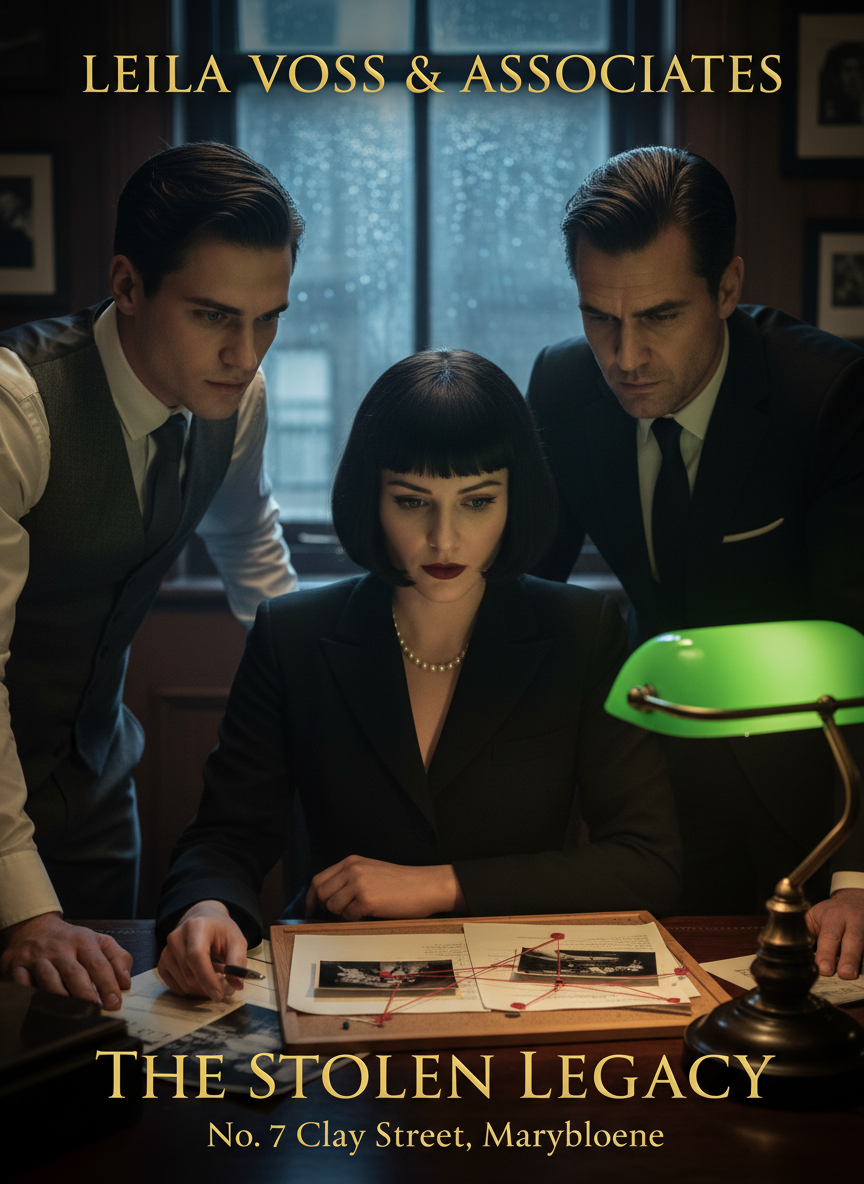
    1940s noir book cover portrait orientation. Over-the-shoulder shot from behind the three detectives, looking towards a large cork case board on the wall covered in black and white photographs, maps, newspaper clippings and red string connecting evidence. Centre: elegant woman with short dark wavy bob, pearl necklace, sharp black suit jacket. Left: young man early 20s with slicked dark hair, dark navy overcoat. Right: young man mid-20s with wavy light brown hair, three-piece grey suit. All three silhouetted slightly from behind, facing the dramatic case board. Green banker's lamp on the desk to the side casting warm glow. Rain on dark window to the side. Very cinematic, moody noir atmosphere. Title text at top in elegant gold serif font: "LEILA VOSS & ASSOCIATES". Subtitle at bottom: "No. 7 Clay Street, Marylebone". No watermarks, no AI branding.

    Pip: No.7 Clay Street, Marylebone — quiet address, discreet brass plate, and apparently the most interesting postcode in 1920s London.

    Mara: Lucy Cordell has been building out the world of Leila Voss and Associates, and today we’re covering the people who run it — the founder herself, and the two operatives who make the work possible.

    Pip: Let’s start with the woman whose name is on the door.

    Who Built the Agency

    Mara: The post on Leila Voss sets out her role plainly: she is the architect of the agency, and the condition her parents attached to the gift of No.7 Clay Street was this — “Use the eyes we taught you. Find the one who is lost — a man who matters to many. When you find him, your new life truly begins.”

    Pip: So the agency began as homework. One case became many, and Norwegian-British, twenty-one years old at the series start, she built it from there — discipline and a leather notebook against all of London.

    Mara: Her brother Elias, five years her senior and commissioned into the Royal Engineers, is worth noting too — their weekly letters are a quiet structural detail, and his correspondence occasionally carries observations that move her cases forward.

    The Operatives Behind the Cases

    Pip: So Leila has the insight and the notebook — what does the agency look like around her?

    Mara: The profile post on Josh Thorne and Pete Smith answers that directly. On Josh: “He is reliable to a fault and often places the safety of others above his own comfort or recognition.”

    Pip: The team’s conscience, then — steady, physically imposing, and the person you want beside you when an investigation moves into the darker parts of the city.

    Mara: His American roots are worth noting — born in the States, relocated to Britain at ten, his parents eventually returned but Josh stayed. That in-between quality, comfortable across cultures, makes him effective in a cosmopolitan 1920s London.

    Pip: And Pete is the other end of the spectrum entirely — slim, floppy-haired, and apparently capable of becoming whoever the room requires.

    Mara: The post describes him as the agency’s chameleon and social scout — private school education, an MP for a father, two military brothers. He understands how different social groups speak and behave, and he mimics those details with precision.

    Pip: Muscle and mirror. Between the three of them, the agency has most angles covered.

    Mara: That’s the shape of it — and the cases themselves are presumably next.


    Pip: A founder with a puzzle for an origin story, a protector, and a man nobody quite catches — that’s a functional unit.

    Mara: The world-building is careful. Worth watching what cases they’re handed next.