The city doesn’t sleep — it waits. Ink-stained clues on a coffee table, shadows pooling between dog-eared pages, and Leila Voss following a trail no one else can see.
Something was stolen long before the crime ever made the papers. In Chapter 2, the past knocks back.
This week, Pip and Mara slip back into the case files for Chapter 1 of The Stolen Legacy — a stolen portrait, a hidden vault map, and a team of investigators boarding the overnight train to Glasgow. The fog is thick, the timetable is unforgiving, and every carriage holds someone who might be reading that map. Spoilers ahead.
Pip: A fog-wrapped London office, a breathless telegram, and a stolen painting hiding a vault map — welcome to detective156, where the mysteries are layered and the 1920s atmosphere is doing serious heavy lifting.
Mara: Lucy Cordell has opened a new serial here, and today we’re stepping into the first case of the Leila Voss and Associates files — a theft in a Glasgow gallery that turns out to be about much more than missing art.
Pip: Let’s start with the empty frame.
The Stolen Legacy
Mara: The Stolen Legacy sets up a serial mystery rooted in 1920s Britain — the question from the very first scene is not just who took the painting, but why, and what they intend to do next.
Pip: The telegram that kicks everything off arrives smudged and urgent, and it already tells you this isn’t a straightforward theft. The message reads: “GOLDEN PORTRAIT STOLEN FROM HUNTERIAN GALLERY STOP FRAME LEFT EMPTY STOP NO TRACE STOP ARTWORK CONCEALS FAMILY SECRETS AND VAULT MAP STOP NEED YOU THREE AGAIN STOP.”
Mara: So the painting isn’t valuable simply as art. What’s hidden beneath the paint — a coded guide to the MacLeod family’s oldest vaults — is what makes it dangerous. The wrong person reading it puts everything the team has previously uncovered at risk.
Pip: And the scene at the gallery confirms the theft was deliberate and unhurried. Two precise, narrow impressions in the dust — not a dragged canvas, but a painting set down carefully. Whoever did this paused. They had a plan beyond simply walking out the door.
Mara: Leila’s read of that detail is the sharpest moment in the chapter. She murmurs, “Whoever took it worked fast. And they haven’t finished yet.” It’s a short line, but it reframes the whole case — the theft isn’t the end of something, it’s the beginning.
Pip: The three investigators each arrive at the problem differently, which is worth noting. Leila reads the physical evidence. Josh flags the operational knowledge required — no alarms, no forced entry, someone who knew the gallery’s blind spots. Pete is already thinking about cover stories and the art-world circles he’ll need to infiltrate.
Mara: That division of approach is established very quickly, and it does a lot of work for a first chapter. The reader understands each character’s role before the team even boards the overnight train north.
Pip: A stolen portrait concealing a vault map, a gallery scene that raises more questions than it answers — the serial format suits this kind of slow reveal.
Mara: And with the clues still in place and the thief clearly not finished, there’s plenty of ground left to cover as the story unfolds.
Pip: A first chapter that hides its real stakes inside a gilded frame — that’s a promising way to open a serial.
Mara: The next instalment will tell us whether the hesitation in that gallery dust means what Leila thinks it does.
Welcome to The Stolen Legacy, a new serialised mystery set in 1920s Britain and following the sharp-eyed detective Leila Voss and her circle of unlikely allies as they unpick secrets, scandals, and a crime that refuses to stay buried.
New chapters arrive regularly and, if you subscribe, each one will slip straight into your inbox for free—no fuss, no spam, just the next piece of the puzzle waiting for you to unfold it.
Chapter 1 is already live and ready to read. You can begin the story here: Read Chapter 1 of The Stolen Legacy, then make sure you don’t miss a step in the investigation by subscribing via the newsletter sign-up on this page.
Thank you for reading and for keeping Leila Voss company in the dark. L. Cordell
The Stolen Legacy is the first case in the Leila Voss & Associates files. Set in 1920s Britain, it follows detective Leila Voss, Josh Thorne, and Pete Smith as they unpick a theft that runs deeper than anyone expects. Each chapter will appear here as the story unfolds in the shadows.
Chapter 1 – The Empty Frame
London to Glasgow – Late Winter, 1920s
The fog in Marylebone was thicker than usual, pressing against the windows of No.7 Clay Street like a silent witness. Inside, the office was quiet—only the scratch of Leila’s pen and the distant rattle of a carriage breaking the stillness. Then the telegram arrived, delivered by a breathless messenger, its paper cheap and ink smudged by haste.
Leila tore it open. Her green eyes scanned the lines, sharpening with every word.
POST OFFICE TELEGRAPHS
GOVERNMENT TELEGRAM FORM
G.P.O.
STAMP
OFFICE OF ORIGIN
LONDON MARYLEBONE
WORDS
27
TIME HANDED IN
9.47 AM
CHARGE
3/6
SERVICE INSTRUCTIONS
EXPRESS — URGENT DELIVERY
DATE
18 FEB 1927
TOMISS L VOSS, 7 CLAY STREET, LONDON
URGENT STOP GOLDEN PORTRAIT STOLEN FROM HUNTERIAN GALLERY STOP FRAME LEFT EMPTY STOP NO TRACE STOP ARTWORK CONCEALS FAMILY SECRETS AND VAULT MAP STOP NEED YOU THREE AGAIN STOP – SIR ALISTAIR MACLEOD
FROMSIR ALISTAIR MACLEOD, GLASGOW
SIGNATURE OF OFFICER
She passed the note to Josh, who stood by the mantelpiece, his tall frame casting a long shadow. Beside him, Pete leaned forward, his expression shifting instantly—from relaxed curiosity to alert readiness.
“The MacLeod portrait,” Leila said, her voice clear and focused. “Regency piece, gilded frame, irreplaceable—not just for its art value. Hidden beneath the paint is a coded guide to their family’s oldest vaults. If the wrong person deciphers it… everything we uncovered before could be at risk.”
“Stolen without a trace?” Josh frowned, his brow furrowing. “That takes inside knowledge. No alarms, no forced entry—only someone who knows the gallery’s secrets and blind spots could manage it.”
Pete grinned faintly, already thinking of disguises and cover stories. “Then we go back. I’ll step into the art world—charm the students, dealers, and hangers-on. They’ll never guess I’m hunting a thief.”
By the following morning, after an overnight train north, they arrived in Glasgow. When they entered the Hunterian Gallery, the scene was exactly as described. There on the green wall hung the magnificent, empty golden frame—carved, ornate, and eerily hollow. Beneath it sat the polished wooden table, untouched but somehow heavy with absence.
The painting was gone. But the clues remained.
Leila crouched beside the frame, running her gaze along its lower edge. The dust on the floor had been disturbed in two places—not the broad smear of a dragged canvas, but two precise, narrow impressions, side by side. Someone had set the painting down here first, carefully, before moving it again. They had hesitated. They had a plan beyond simply taking it.
“Whoever took it worked fast,” she murmured. “And they haven’t finished yet.”
A simple one-time payment link or button — amounts like £3, £5, £10, or custom
“Writing Leila Voss & Associates is my passion — if you’d like to support the mysteries, you can now do so here. Every contribution helps bring the next case to life!
Pip: No.7 Clay Street, Marylebone — quiet address, discreet brass plate, and apparently the most interesting postcode in 1920s London.
Mara: Lucy Cordell has been building out the world of Leila Voss and Associates, and today we’re covering the people who run it — the founder herself, and the two operatives who make the work possible.
Pip: Let’s start with the woman whose name is on the door.
Who Built the Agency
Mara: The post on Leila Voss sets out her role plainly: she is the architect of the agency, and the condition her parents attached to the gift of No.7 Clay Street was this — “Use the eyes we taught you. Find the one who is lost — a man who matters to many. When you find him, your new life truly begins.”
Pip: So the agency began as homework. One case became many, and Norwegian-British, twenty-one years old at the series start, she built it from there — discipline and a leather notebook against all of London.
Mara: Her brother Elias, five years her senior and commissioned into the Royal Engineers, is worth noting too — their weekly letters are a quiet structural detail, and his correspondence occasionally carries observations that move her cases forward.
The Operatives Behind the Cases
Pip: So Leila has the insight and the notebook — what does the agency look like around her?
Mara: The profile post on Josh Thorne and Pete Smith answers that directly. On Josh: “He is reliable to a fault and often places the safety of others above his own comfort or recognition.”
Pip: The team’s conscience, then — steady, physically imposing, and the person you want beside you when an investigation moves into the darker parts of the city.
Mara: His American roots are worth noting — born in the States, relocated to Britain at ten, his parents eventually returned but Josh stayed. That in-between quality, comfortable across cultures, makes him effective in a cosmopolitan 1920s London.
Pip: And Pete is the other end of the spectrum entirely — slim, floppy-haired, and apparently capable of becoming whoever the room requires.
Mara: The post describes him as the agency’s chameleon and social scout — private school education, an MP for a father, two military brothers. He understands how different social groups speak and behave, and he mimics those details with precision.
Pip: Muscle and mirror. Between the three of them, the agency has most angles covered.
Mara: That’s the shape of it — and the cases themselves are presumably next.
Pip: A founder with a puzzle for an origin story, a protector, and a man nobody quite catches — that’s a functional unit.
Mara: The world-building is careful. Worth watching what cases they’re handed next.
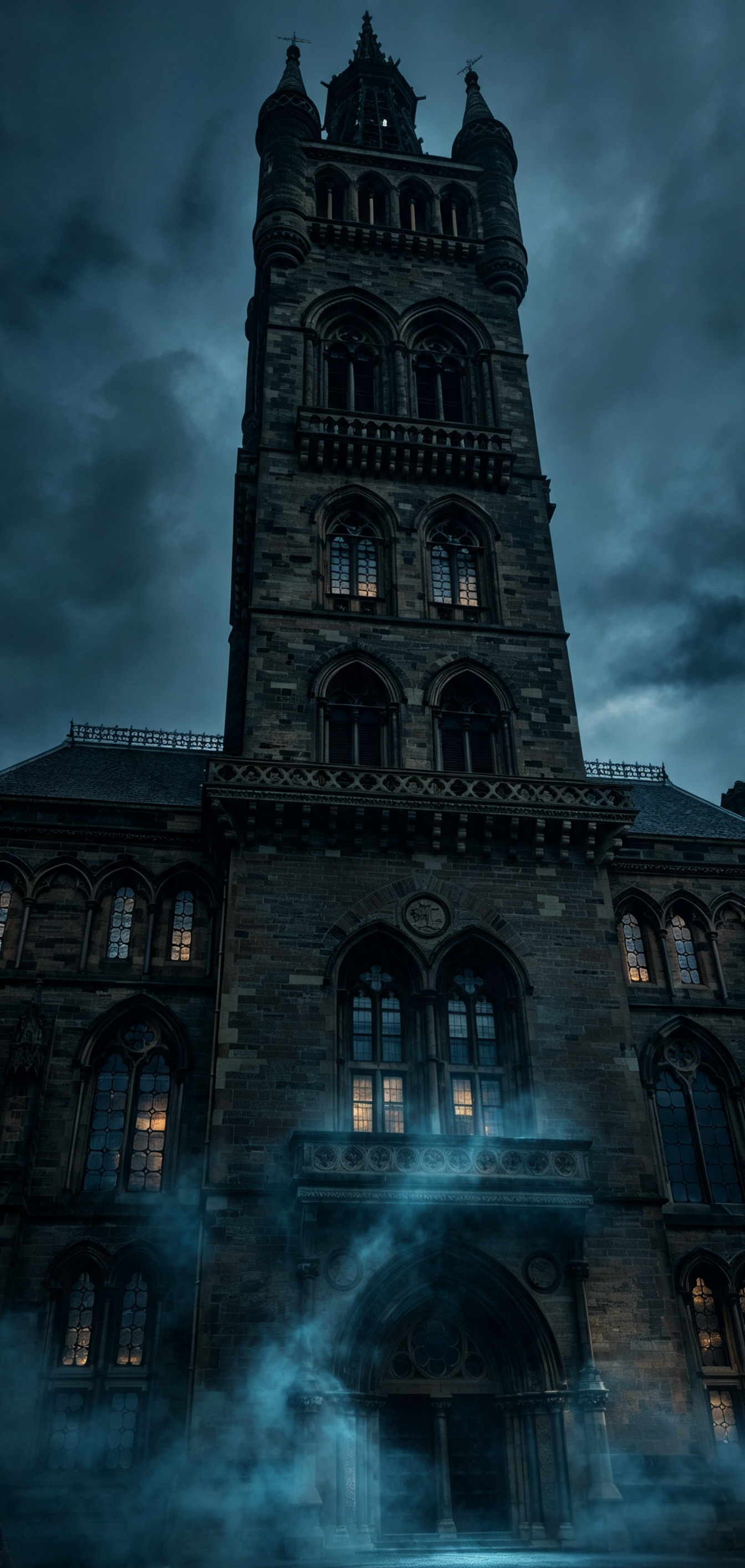
Scotland has a way of getting under your skin. One rain-soaked weekend in Glasgow was all it took to spark a new case in my detective series—a story that begins beneath the university tower, where the stone remembers more than it should.
Beneath the grand Gothic spires of the University of Glasgow lies a history steeped in whispers. Corridors run dark and narrow, stairwells twist into shadow, and the air tastes of dust, ink, and secrets long buried.
Designed by Sir George Gilbert Scott, the Main Building looms over the city like a watchful witness. Its sandstone arches, vaulted ceilings, and cloistered quads make the perfect stage for a mystery that doesn’t want to be solved.
A Missing Student. A Trail of Notes. The Vaults Below.
Glasgow, 1920s. A student vanishes after claiming to have uncovered something hidden beneath the university. No body. No witnesses. Just a trail of cryptic notes, each one stranger than the last.
Leila, Josh, and Pete pick up the trail, chasing those notes down through forgotten stairwells and locked doors, until the campus gives way to the old vaults—a maze of stone, silence, and stale, unmoving air.
Down there, the dark presses in. Footsteps echo where no one walks. The handwriting on the final note looks fresh, as if someone had been waiting for them to arrive.
What secrets lie beneath the tower? What did that missing student really find in the vaults? And when Leila, Josh, and Pete finally reach the heart of the maze, will they uncover the truth—or simply join the list of names that never came back?
The Vaults of Glasgow — a new 1920s detective mystery, coming soon.
Character Reference Sheet: Leila Voss & Associates
Key supporting operatives in the 1920s London detective agency Leila Voss & Associates, profiled for internal reference and story continuity.
Josh Thorne
Basic Identity
Age 28. American-born operative who relocated to Britain at the age of ten. Now a long-term resident of London, he moves easily between American and English sensibilities, making him a natural bridge between cultures in the cosmopolitan city of the 1920s.
Voice: Speaks with an English accent softened by a smooth, subtle American lilt.
Family & Background
Born in the United States to a military father, Josh moved to the United Kingdom with his parents and younger sisters when he was ten. Five years prior to the events of the series, his parents returned to America, but Josh chose to remain in Britain. His decision to stay reflects both his independence and his attachment to London, which he now regards as home.
Physical Appearance
Tall, handsome, and muscular, Josh has the build of a soldier or boxer, which immediately signals that he is capable of handling himself in dangerous situations. His presence is quietly imposing rather than showy, giving him a grounded, reassuring air when walking the fogbound streets.
Key Personality Traits
Steady, loyal, and deeply protective of his colleagues. Josh prefers careful observation over rash action and has a calm temperament that helps to defuse tension. He is reliable to a fault and often places the safety of others above his own comfort or recognition.
Skills & Strengths
Physically strong and resilient, Josh functions as the team’s shield when investigations turn dangerous. His military family background gives him a working understanding of discipline, tactics, and chain of command. He has good street awareness, excellent stamina, and a talent for remaining calm under pressure, making him effective in surveillance, escort, and extraction work.
Role in the Group
Josh is the loyal protector of Leila Voss & Associates, serving as physical backup on field operations and a stabilising influence within the team. When cases lead into the darker corners of 1920s London, he is the one colleagues trust to walk beside them, steady and vigilant, ensuring they make it back to the agency in one piece.
Pete Smith
Basic Identity
English-born operative working out of London in the 1920s. Pete is quick, clever, and effortlessly charming, moving through the city’s social layers with ease. His easy manner and quick wit often disarm suspicion before questions are even asked.
Family & Background
Pete grew up in a disciplined but intellectually engaged household: his father is a Member of Parliament, his mother a teacher. He has two older brothers, both in the military, one a year older and the other five years his senior. Their example, combined with his parents’ expectations, gave Pete an insider’s understanding of politics, protocol, and social performance.
Educated at a private school, he is well-read and articulate, able to pass easily among the upper and middle classes while still understanding the concerns of those below stairs.
Physical Appearance
Pete is slim, with floppy blond hair and an open, engaging face. His build and features allow him to shift from unassuming bystander to polished gentleman or street urchin with a change of posture, clothing, and expression.
Key Personality Traits
Cheeky, charming, and irreverent on the surface, Pete is nonetheless sharply observant. He enjoys verbal sparring, improvisation, and misdirection, and he rarely shows the full extent of what he knows. He is restless, quick-thinking, and difficult to pin down—socially or geographically.
Skills & Strengths
A master of disguises, Pete can alter his voice, bearing, and appearance to inhabit a wide range of personas. His strong education supports this talent: he understands how different social groups speak, dress, and behave, and he mimics these details with precision. He excels at infiltration, impersonation, and gathering information in places where the agency would otherwise have no access.
Role in the Group
Within Leila Voss & Associates, Pete is the chameleon and social scout. While others provide muscle or strategic oversight, he slips through parties, clubs, and back alleys in borrowed faces, returning with crucial details that move cases forward. In the shifting shadows of 1920s London, he is the operative no one quite manages to catch—or forget.
Thanks for reading this quick sneak peek of Leila Voss!This is only a taster — coming soon there’ll be a full detailed profile page diving deeper into Leila’s story, background and secrets.
After that, we’ll meet her fellow detectives:
●Next up: the loyal, protective Josh Thorne ●Then: charming master of disguise Pete Smith
Watch this space — more characters, foggy London mysteries and 1920s atmosphere are on the way!
Pip: Detective fiction, 1920s London, fog rolling in off the Thames — someone at detective156 has decided the world needs more mysteries, and honestly, they’re not wrong.
Mara: That’s the territory today. lucylu2011f4f73ab96b has opened a new creative writing blog and we’re here at the very beginning — the launch post, the premise, the promise of a whole series to come. Let’s start with what this journey is actually about.
New creative writing journey!!
Pip: The question this post answers is deceptively simple: what is this blog, and why should you follow it? The answer turns out to be quite specific — this isn’t a general writing diary, it’s a commitment to document an entire creative project from first word to last.
Mara: The post sets the scene directly, and the promise is right there in the opening lines: “Join me in this brand new writing journey and I’ll share with you some of the creative ideas, plans, this blog will follow the whole process from start to finish.”
Pip: That “start to finish” framing matters. This isn’t a highlights reel — it’s a process blog, which means readers are being invited in before the answers exist. The mess, the decisions, the dead ends — all of it, presumably, on the table.
Mara: And the project itself is well-defined. It’s a Detective Mystery Series, set in London during the 1920s — the post describes the setting as “the glamour, fog, and hidden secrets of London.” The era does a lot of work: the 1920s gives you post-war tension, a particular class anxiety, and a city in the middle of reinventing itself.
Pip: A detective agency run by a woman named Leila Voss, operating out of No. 7 Clay Street in Marylebone — that’s a proper address, which suggests the world-building is already underway before the first story is written.
Mara: The post closes warmly — “I’m so glad you’re here to watch these mysteries unfold” — which sets the tone as collaborative rather than performative. The reader is a companion, not an audience.
Pip: Whether the fog stays atmospheric or becomes a metaphor for something thornier is, I suppose, exactly what we’re here to find out.
Mara: The series hasn’t begun yet — what we have is a premise, a place, and a detective with her name above the door.
Pip: Which, for a mystery, is exactly the right amount of information to give away. More next time.